Friday, 3 January 2014

Final thoughts

Using influences from Roland Barthes, I feel that my images will (hopefully) create an intense 'punctum' (the defining element of an image that 'pierces' the spectator) for the viewer. I cannot say what these punctums may be, as they are always subjective to each individual viewer. 
I feel that I've successfully captured subtle hints of Arlo's child innocence. I like the fact that the viewer can view the images in their own individual way, finding their own opinions of what makes each particular image relatable to childhood. As David Bate states 'the meanings of [images] are always corrupted by these processes of spectatorship, such that the viewer invests their meaning based on their relationship with the signifying element of the extant portrait'. This statement implies inherently with my project - I have created a set of images that viewers can view in their own individual way; I am not forcing them to think in any particular manner.
I hope my photographs will enable people to feel something - whether that be nostalgic, in awe, happy or sad - ultimately I have created something that everyone can relate to: childhood.

Thursday, 2 January 2014

Favourite images comments

This image remains my favourite photo. I love everything about it - the shadows, his bright blue eyes, his positioning, how his monobrow creeps out below his fringe, his fringe, the small pink areas around his eyes, the introduction to his little button nose, and that fact that there's no background to distract away from him. The tones are exactly what I wanted to achieve, not too bright as to suggest an idealised view of childhood, but not too dark and dull to suggest morbidity or dullness. I love how his right eye is in complete focus, but his left eye is slightly blurred - my eyes are drawn towards his right eye, and I wonder what he's looking at or thinking. The image isn't too close up as to alienate the audience, they can clearly tell that it's a young child, and they are given glimpses of his traits. This is exactly what I wanted to achieve. In terms of child innocence, I wanted to capture his monobrow to show the fact that he doesn't care - he is too young to even notice, he doesn't have a sense of self consciousness yet, which is lovely. When he gets older he will probably hate this photo, hate his monobrow, but for now, his innocence shows his carelessness, which to me, is beautiful.

This image is very similar to the above image. This time, Arlo had had a haircut, which revealed his monobrow in full swing. I love how his fringe perfectly mimics the line of his monobrow. I love how the fringe is freshly cut, so I can see each strand, and how it isn't a complete block - the fringe is separated into parts. I like that he's looking at the camera willingly - I didn't, and never have, asked him to look at the camera, he was simply checking out what I was doing. His eyes seem a lot darker in this photo, which is strange as I hadn't edited his eyes in either photo - maybe the lighting had something to do with it? Similarly to the above image, his right eye is in focus and his left isn't. I like how the photo was taken on his eyeline - as a viewer, I feel that he's looking right at me, and that I'm on his level - I'm not to feel superior or inferior to him. The dark blue in the background on the left of the image is the only thing I do not like. I would have preferred to have gone in a little closer as to eliminate any background, however, I suppose it's not too distracting as it's one solid colour, as opposed to lots of objects or colours.

It took me a while to like this photo, and I'm still not 100% sold. My aim was to capture Arlo's dry skin around his mouth - he had a cold this day, but has also always had sensitive skin, so often has red patches or eczema. I wanted to capture this to suggest that most children get ill quite often, whether chicken pox, bugs, or allergies - it's the time when the immune system is really tested. In this photo, his dry skin is clearly agitating him as he's licking it with his tongue. He did this a few times whilst photographing him. I liked this photo best as not only is his tongue out to suggest that, but the lines and curves created on his chin interest me. I can't really explain why, nor do I know why. Maybe it mimics a funny face being pulled - I'm not sure, I supposed this is my own version of the punctum of the photo (a la Barthes). But I also like how he has a dimple in this image. Dimples are generally related to children - by him licking his rough skin, his chubby cheeks are forced upwards and a dimple is created. It's cute in an ironic way, and I like it. Once again, I'm not too keen on the background. I like how there is a subtle hint of his neck and tshirt, which I supposed couldn't be captured without some background, but as mentioned before, I would have preferred an even closer view.

I think this image represents child innocence very well. The main focus is Arlo's arm reached out, which is holding his grandma's hand. It sums up children quite well - they need to be looked after, but they also want to be looked after. He doesn't want to be alone, he needs us to look after him. The clasping of hands represents this - he is young, he is vulnerable, he needs help to grow. I also like that  he is snuggled into his coat hood, which also suggests his youth - his hood is too big for him, but he enjoys being inside as he feels safe. It is his cocoon, as is holding his grandma's hand. In terms of the photo as a whole, it doesn't abide by my "rule" of being close up. Yes, it is close, yes it doesn't show Arlo's whole face, but there is a lot of background. I suppose it would be hard to achieve a very close up image of them holding hands, with also a small amount of Arlo's face in the photo without there being some sort of background. However this is a photo I'd like to attempt again. But, the suggestions the image gives does relate well to my project as a whole.

I spent a long time with Arlo whilst he was playing. Trains are his utmost favourite things. If he could spend all day at a train station, he would. I knew I wanted to capture this obsession of his somehow. At first I found it quite hard, as he constantly moved around and it was very tricky to get a close up of him whilst playing with the toys, and to get the two things in the same shot. It was after a while that I managed to get this shot. Arlo had been playing for probably an hour, and I supposed he was tired or was slowing down, and put his head on the track to look through a tunnel which his train had just gone through. This photo was the outcome. I love how we view Arlo in close up, but through a train tunnel. His face is framed by this tunnel, and we are drawn to look through the tunnel at him. I like that there's little background, but I also like that we're able to tell that he's leaning on his hand to protect his head from the floor. I like that this photo is the most colourful, as he is playing, and generally play is colourful. It's probably the most important part of childhood.

Every image portrays some form of Arlo's innocence and youth. The whole inspiration for this project was the fact that he was the only person I took a photo of in my family who didn't care - he didn't care that I was taking a photo of him, and ultimately, I put that down to his innocence. Generally people don't like having their photo taken because they are aware that it is not their photo - someone else will have a photo of them, whether they like it or not. As Barthes says, 'this disturbance is ultimately one of ownership'. It may be their portrait, but it isn't their image - their photo was taken. But Arlo is too young to understand this notion, therefore, he doesn't care. His carelessness and innocence is what inspired me to create a set of photographs aimed around him and his life, which I feel has been captured in a subtle but effective way.


How my project could progress

Although I have captured some decent images, there are ways that I could improve the project.
For example, my main aim was to produce images that relate to child innocence through close-up photographs. As I have previously mentioned, I wanted to capture these during Arlo's daily routine, as to not bother him and to capture as natural images as possible. Although I have achieved this, there are some images that I would re-do or spend more time on. For example, the images I wanted to capture of him with a messy mouth haven't turned out the way I initially expected - they aren't as close up as I wanted, show a lot of background (even though it's out of focus) and in this case, his face isn't quite as messy as I'd like. My original plan was to capture Arlo eating a yoghurt, which generally gets quite messy, however he was ill on the day and wasn't allowed to eat yoghurt. 
I would have also liked to have captured Arlo laughing - he is such a funny boy that I don't think I've captured that part of his personality very well within the images taken so far. 
Therefore, it is indeed best to look at this project as a 'work in progress'. Time is what is needed to progress - more time spent with Arlo to capture his life. However, having said that, I do believe my images portray not only his personality, but traits that relate to child innocence that many can identify with. Such as his soft, young skin; his button-nose; his blunt fringe; etc. 
As previously said, it's up to the viewers to put their own ideas upon my images. Whatever the audience may think or feel, ultimately they are looking into the world of a young boy, which hopefully will create a sense of nostalgia.
So, overall, the project could be improved by spending more time with Arlo to capture every possible moment, whilst also ensuring I take close-ups with minimal background as to not distract away from the main subject. But I think I'm on the right track so far.

Favourite overall photos

Below are my favourite images from all of my photo shoots.


Wednesday, 1 January 2014

Thoughts on photos

I'm quite pleased with my photos. I've managed to capture moments I hadn't ever thought about; following my nephew around really opened my eyes up into his little world. 
I think, in hindsight, it was quite ambitious of me to have sketched out exactly how I wanted my photos to turn out. There is no possible way I can force my nephew to pose in particular ways, particularly the "crying" idea I had (to literally capture my nephew crying), as firstly, he doesn't cry that often; and secondly, if he were to cry I would be the worst auntie ever to not console him, but instead smack a camera in his face! Although it would have been a good addition to the array of different ways that Arlo represents/expresses his child innocence, I don't think it's the end of the world. Besides, this is supposed to be a "work in progress" project, in that it can be explored further afterwards.
My thoughts generally turn to Arlo himself. The photos I've captured of him show him in so many different ways - his blunt fringe, his monobrow which he doesn't even know exists, his small, button nose, his super soft young skin, contrasted with his rough, dry, eczema around his mouth when he was ill, to his vulnerability in his massive coat, his silliness with his tongue out, and so much more. I think my photos represent child innocence, particularly Arlo's, in a subtle but interesting way - I haven't made it super obvious as to what the viewers need to be looking at, or should find - they will find it for themselves. Using Roland Barthes' terms, I give the audience a studium to look at (ie, they are faced with a young boy), but the way they view the images is up to them. Ultimately, the description, emotion or feeling they experience by viewing the photos is up to them. If they find a 'punctum' (something that "pierces" the viewer) within the image, it will be of their own subjective ideas. It may be the tuft in his mono brow that curls up, or his bright blue eyes, or the way his fringe sits perfectly adjacent to his eyebrows... anything. It's up to the viewer.
So, what I'm trying to say, is that my images came out slightly differently to what I had imagined and sketched. But this is not a bad thing. I am pleasantly surprised at the subtle nudges towards child innocence in my photographs. I like how the audience aren't forced to think something - they are given enough freedom to put their own thoughts and opinions on the photos.

Favourite photos

Below are a selection of my favourite photos taken from the last three shoots. I have edited them all because, as mentioned previously, I find it easier to know if I really like a photo post-edit.


Tuesday, 31 December 2013

Choosing the best photos

By shooting non-stop, as my nephew moves a lot, I have accumulated a LOT of photos. It takes a long time to narrow them down. 
Firstly, I look back at my contact sheets and write down which photos I like the look of and the ones that best fit my project brief.
I then go back through the contact sheets again, re-looking at the images I've jotted down, and pick my favourites from the favourites - usually these will be the best in terms of fitting my brief, and if I have any that I really personally like.
My next step is to then open each image on Photoshop, where I have a larger view of the photos, and then if I still like them, I'll edit them. 
After the edit, I'll decide if I think they're worthy of being used.
I will show my favourites in the next post.

Final shoots

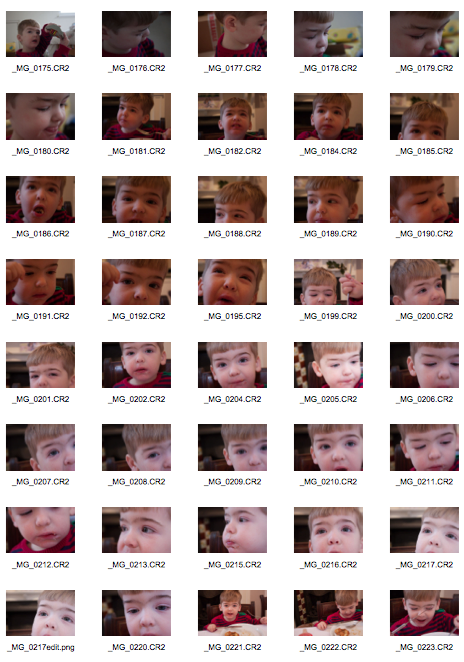
Below are the contact sheets for my last three shoots. All shot on one day, I was following my nephew around with my camera like a hawk as I knew it would be the last day I'd see him. I've split them into three separate shoots - one with him eating, one of him watching tv/playing with an iPhone and the last of him outdoors in the park.


Equipment

As mentioned before, I'm using a Canon 40D to shoot with. This is an upgrade to what I usually shoot with (Canon 300D).
I have two lenses, the standard 18-55mm lens and a 50mm lens. The majority of the time I have been shooting with the standard 18-55mm lens, as it has the zoom option which works well with the nature of my close-up images. As the 50mm lens doesn't have a zoom option, it's harder to follow my active nephew around to get the right shots - and it also means I have to be REALLY in his face and intrusive. Although the 50mm lens does create amazing depth of fields, overall the standard 18-55mm lens won.
The speedlite used is also shown, it also had a remote to use so that the flash worked separately to the camera, but I decided to not use it. The screen on the speedlite is where the power is adjustable, and at the top of the speedlite (where the flash is which isn't visible in the photo), is the diffusion card. It slots out to diffuse the flash light, which ultimately makes the flash softer.

Monday, 30 December 2013

Explaining aperture

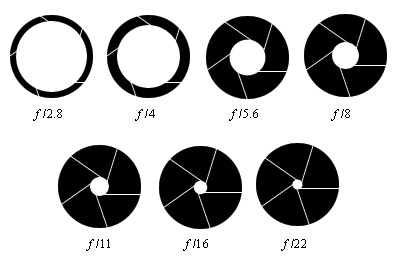
As I've been mentioning aperture, f-stops and shutter speeds in my past posts, I thought I'd dedicate one especially to it.

Above is a diagram of f-stops. Ultimately it shows that the higher the f-stop, the wider the aperture opens which therefore lets more light in. For example, if in low-light conditions, you'd use a higher f-stop so that more light is exposed to the camera. With this higher f-stop comes slower shutter speeds, as they work hand-in-hand. This means that when shooting in a low f-stop, the shutter speed will leave the aperture open for longer to let more light in. Generally this means that there is more likely to be blur in the photo, unless using a tripod or very still hand, as the shutter is open for longer.
The same goes for good light conditions. If in good light, a higher f-stop is needed to let less light in, which corresponds with a faster shutter speed. 

Aperture is also related directly to depth of field, which refers to how much of a photo is in focus. For example, a larger aperture means less will be in focus - ie, with a portrait of a person, their whole face may be in focus, but the background is out of focus. This also works the other way round, with a smaller aperture (so a higher f-stop number) the whole scene should be in focus, such as a landscape photo. So therefore, the smaller the f-stop, the smaller the depth of field, and the higher the f-stop, the larger the depth of field.

Experimenting with lights

As promised, I was going to experiment with artificial light, which isn't something I usually use in photography as I like my images to be as natural as possible. I took the chance to experiment with light whilst my nephew was eating, which I thought might be successful in trying to capture him with a messy mouth.
I used a speedlite which I attached to the top of my camera and adjusted to suit my needs. 
The photos below, which are all unedited, are of both the natural light used in the room and the speed light. I didn't have a light meter to hand, so I used my own eyes to determine the best light, power and aperture to use.


The room I shot in had one fairly large window which, as you can probably tell, was located to the left of my nephew. It doesn't let in too much light because it's situated behind a wall, the most light it sees is around sunset. However, I was shooting in the afternoon on a winter's day. The most obvious thing to me is that the images have quite a lot of noise. They aren't sharp, they're all slightly blurred, which is due to having to have a lower f-stop to let in more light, which delays the shutter speed and ultimately the movement from my nephew (and indeed me) creates blur. The natural light creates natural shadows and light on my nephew's face, which I like as it creates depth and tones that I don't think a flash could achieve. 


By attaching the speedlite to the top of my camera and adjusting the angle of the light towards walls to bounce the light off, I achieved these images. Similarly to the first set of photos without the flash, they are all blurry. I think this was because I hadn't yet adjusted my camera's aperture, I was simply trying to find the best way to attempt to create a natural-looking light. My first thoughts were that the flash was too strong as it was bouncing off the chair my nephew is sat on, which creates a harsh light in the photos. Also, I wasn't angling the flash correctly, as it wasn't capturing my nephew's face, but was getting the background objects. When I did adjust it slightly (as seen in the last photo), the light did bounce off my nephew's face, making it lighter, but was too harsh. I therefore adjusted the speed light's power, lowering until the light looked "right". Noticeably, the natural shadows shown in the first set of images had disappeared.
In these last three photos, I angled the speedlite from pointing to the ceiling to looking at the side wall (to the right). I also added a diffusion card to soften the light, as the previous photos came out too harsh, even with the power of the light turned down to its lowest. I also adjusted the aperture to work with the new light settings. Overall these images came out well once I'd got everything "right"! The first image is too light for me, too unnatural, I'm not sure why this one was different to the other two as I was using all the same settings - possibly the particular angle of either me or my nephew. The last two images came out well - they are generally focused, much more than without the flash, however his fringe is still blurred, but that probably has more to do with my own focusing (I was using auto focus, which can be temperamental when taking photos close up). The diffuser definitely helps to soften the flash, as shown by looking at the chair - in the second set of photos using a harsh flash, the light reflected off the chair which created a very unnatural effect. However, the diffuser (along with the different angle of the flash), help to eliminate this harshness. 
Although not perfect, the speed light does have its advantages. Once all the settings are right and the correct balance is found, natural looking photos can indeed be achieved in poor light. The most important parts are angling the flash correctly and making sure I'm using the right aperture. The aperture ultimately changes every time the flash changes in any way. If I hadn't constantly changed f-stop, then the images would have been either overexposed or dark and noisy. 

Although I do see the benefits of using speedlites, and indeed mono lights, soft boxes and light umbrellas (which I have experimented with before in my past projects), the nature of my project this year (and indeed last year) suggests that natural light is better. Obviously I am bias as I much prefer to shoot in natural light anyway, as nothing can compare to natural shadows, light and tones, however I do honestly believe that using natural light is the way forward for me with this project. Adjusting the lighting takes up precious time with my nephew, who constantly moves and wants to do this or that - why faff around with lights when I can take photos in well lit rooms? Or indeed, outside, where light is generally not a problem in the day time.